Check out the video below about female "strongman" competitors that I stumbled across today. I am psyched to have found a number of female clients who are getting more interested in performance and in getting strong as hell. The video will perhaps help dispel some of the myths about strength training making women bulky, "unfeminine" or whatever. Personally I think that "feminine" should mean whatever you want it to mean. Some women are able to redefine femininity and others reject the concept outright. Power to them both!


Will strength training make me bulky? I get this question from women all the time. I think it is largely fueled by photos of female bodybuilders.

If I could state the answer any more clearly I would but I think I can reduce it to one word: "no."

Women, on average, have 1/10th the testosterone of men. This is more or less the bottom line. The image of huge muscular women that many fear is almost always a drug-fueled aesthetic.

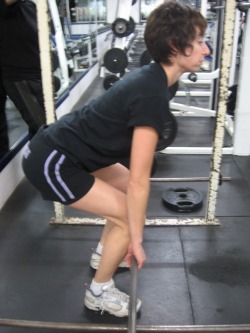
The good news is that women can get much stronger through strength training than they are in their untrained state. This can significantly aid performance as well as making one more resistant to injury.

If you are a highly unusual genetic specimen and find yourself getting truly "bulky" then you can choose to stop training. The training effect does reverse over time.
-----------------
note: I first published this article at Derby Conditioning. Have a visit if you are interested in flat track roller derby.


The following article, on adopting an athlete's mindset, is one which I wrote for Derby Conditioning. Roller derby competitors may want to check that brand new site out!

Flat track roller derby is a dangerous sport. First of all there is the contact: women are trying to knock each other around and down on the track, and some play dirty. Secondly you are competing on a very hard surface. Thirdly, and not least importantly, this is all taking place on roller skates.

Many derby competitors are in their thirties and older, come from decidedly non-athletic backgrounds, and enjoy the raucous partying that comes along with the roller derby subculture.  

A sincere commitment to strengthening and conditioning oneself and one’s teammates makes a great deal of sense in this situation. This means a commitment to pursuing athletic goals outside of practice time. It means living a more athletic lifestyle. This all starts with a change in mindset.

The change of mindset that I am advocating is to think of yourself as an athlete.

Being an athlete does not preclude partying. What it does demand is physical and mental preparation, attention to nutrition, enough sleep, and amongst other things a lifestyle that allows you to recover from demanding training and which engenders solid performance. As a roller derby athlete, seeing as you are involved in a punishing sport, the risks of ignoring these basic considerations deserves deep consideration.  

You are an athlete in a contact sport. You’ve probably seen the injuries, heard the stories, felt the thrill of danger. Football players, rugby players, wrestlers, boxers, MMA fighters are all expected to train outside of formal sessions. They all must take their strength, fitness and mental readiness seriously. The risks you share are not dissimilar.  
 
During the off-season it is important to develop your  general athleticism, your capacity for strength and power, your mobility, your conditioning, and so on. Because you are not attending and recovering from derby-specific training sessions it is important to do this work three or more times weekly whenever possible.

As team practices and the season begins it is important to maintain the strength, power and other qualities which you worked so hard hand during the off-season. You will not be able to hit the supplementary sessions as frequently but try for twice weekly, or at least once. Plan your training around your derby-specific sessions and your bouts. You must have adequate recovery so that you are able to develop the technical aspects of your game and so that you are feeling buoyant and ready to rumble as your bouts approach.

Take a little bit of down time after your season, just enough to feel fresh again. Then begin another cycle of developing yourself to your athletic potential. If you work harder and more intelligently than your opponents then not only will you be more resistant to injury but you will be more likely to dominate the track.